Impact Echo (or dynamic impedance) is an acoustic non-destructive test method used to assess the dimensions and integrity of concrete and masonary structures. GBG has undertaken a large number of NDT projects using Impact Echo method. Typical applications include: Pile Depth Testing, Measuring Slab Thickness, Locating the extent of delamination/honeycombing and voiding around reinforcing bars and concrete cancer. GBG Australia has completed numerous projects to determine the depth of piles on railway stanchion Overhead Wiring Structures (OHWS).
Thermal Tomography is an example of infrared imaging science that detects the changes in the infrared radiation from objects. GBG Australia have used this technique to great effect in examining for voids behind weather proofing on large concrete structures and to examine wall cavities without the need to penetrate the walls. Thermal Tomography is a quick and efficient alternative to Ground Penetrating Radar (GPR) in some situations and is a rapidly growing technique which is fast becoming highly sort after.
GBG utilise impulse radar, Covermeter, Schmidt Hammer, Ultrasonic testing and Impact Echo testing to cater to a wide range of slab investigations. We can provide full slab specifications such as reinforcement detail, concrete strength, delaminations, thickness and service and post tension location. NDT is vital before penetrating a slab where plans showing post tensioning cables or utility services are nonexistent or inaccurate.
NDT can provide invaluable information on the subsurface condition of bridge components. Our methods allow for detection of internal problems far more effectively than a visual inspection alone. GBG Australia is experienced in surveying concrete, masonary and timber bridges to determine material conditions and integrity, reinforcement detail, concrete strength and construction problems. Furthermore we have investigated and provided information for historical timber bridges to the satisfaction of our clients needs without damage.
We can offer complete building specifications where plans may be lacking or unreliable. We can extend our slab investigations to walls, columns and ceilings to produce important information which may be vital when additional/proposed development on existing buildings. We are able to locate voids, moisture content and corrosion levels within concrete. GBG Australia has undertaken work on heritage buildings to determine the nature of the construction materials.
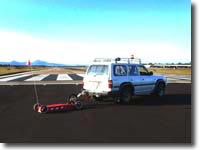
Due to time constriants and access, GBG Australia can provide non-destructive investigations that can obtain essential engineering information on the construction thicknesses and condition of the pavement efficiently. Moreover without physical impact on the pavement (Non-Destructive).We can work around time restrictions and work in corelation with the client or maintence. We obtain the information using DGPS, linked to multiple Ground Penetrating Radar systems. We can profile to collect the extent of the pavement construction and condition on the runways,the taxiways or hardstand areas. This information can be used with targeted cores or other pavement investigation methods such as Falling Weight Deflectometer (FWD) to provide a holistic approach to pavement life assessment and pre-planning for maintenance or replacement.
We have undertaken investigations in major and local commercial airports as well as military bases within Australia providing information on construction layer thickness, delaminating in asphalt layers, voids under slabs, reinforcement detail and changes in pavement construction.
The collected information is analysed and interpreted to provide engineering information in usable format often as ACAD drawings with a written report detailing and discussing the results. We can often provide recommendations for remediation and repair strategies if required, using our in house geotechnical and engineering capabilities.
Large hardstand areas in ports or major distribution centres are often in full use and cannot be taken out of service for extentive periods of time. Using non-destructive assessment methods such as Ground Penetrating Radar (GPR), Falling Weight Deflectometer (FWD) or Impact Echo (dynamic impendence) structural information on the hardstand construction and condition can be provided over a large area in a restricted time frame. GBG have provided information on concrete defects, reinforcement detail, location of support piers/piles, presence of voiding around services, within and under slabs. In addition construction layer thickness and condition.
We are able to provide detailed information using one of the premier tools for road pavement investigation, Ground Pentrating Radar(GPR). Expected results include: pavement thickness, pavement construction, location of buried utilities, delaminations, voids and pavement condition. Moreover,thicknesses of construction materials can be resolved down to one inch thick. We also utilise other geotechnical methods including Depth Core Penetration (DCP) testing and Muilt-channel Analysis Surface Waves (MASW) to provide a more thorough dataset, depending on the scope of the investigation.
We offer a suite of investigative techniques to locate underground utilities. We correlate our GPR and cable/pipe locator results with any known information and accessible service pits. GPR is superior to the standard cable /pipe locator as it can detect pipes not made of metal (eg. PVC). The knowledge of the location of utilities can avoid unnecessary, costly and dangerous disruptions to planned works. Utility provided information is used but can be erroneous, geophysical techniques can quickly and easily identify the precise location of buried services.
GBG Australia has undertaken numerous surveys of water aqueducts and culverts as well as sewer pipes. Objectives of the surveys can vary from determining concrete thickness, harness and strength, to mapping reinforcement detail with GPR, visual inspections, locating cracking or voiding in the soil under the concrete. GBG can detect the location of water infrastructure at a site without drilling or digging. The use of geophysical techniques provides a quick and effective characterisation of any faults or defects in construction and greatly reduces the cost of repair.
GBG Australia can survey the concrete of water retention structures such as water tanks, swimming pools and wells. Using Ground Penetrating Radar (GPR), the condition of the concrete and reinforcement can be characterised. In some instances radar and impact echo can detect zones of honeycombed concrete, leaking of the construction joints, voiding around reinforcing bars or variations in reinforcement detail. GBG Australia provides reporting on the location and type of fault in the concrete to aid in the repair of the structure.